Splunk Integration With ShareFile
Overview
To download audit logs from ShareFile, users had to previously integrate with third party APIs for compliance monitoring. This is inefficient, prone to human error, and lacks scalability for organizations.
To remediate this, ShareFile now provides native SIEM integration with Splunk, a leading SIEM tool for admins to collect, normalize, and analyze logs and alerts to detect threats and automate responses.
SIEM (Security Information and Event Management) is a foundational cybersecurity solution that aggregates and analyzes log data from across an organization’s digital infrastructure. It serves as a centralized command center, helping security teams detect, investigate, and respond to cyber threats in real-time.
With this integration, ShareFile now provides users with the ability to programmatically stream structured audit logs and activity events (uploads, downloads, shares, access changes, etc.) directly for compliance, monitoring, and threat detection.
Key Benefits
SIEM integration seamlessly allows ShareFile users to:
- Configure SIEM integrations
- Ingest ShareFile activity logs and security alerts
- Build basic monitoring and detection workflows
- Troubleshoot common issues
How to set up Splunk Integration with ShareFile
You need to create a Splunk account prior to integrating with ShareFile. There are mostly 3 requirements for successful integration with ShareFile:
- HEC Endpoint URL: This is the Splunk instance of endpoint URL
- HEC Token/Key: This is for authenticating Splunk API with ShareFile.
- Index: This is the repository where the processed data is allocated. By default, index is main.
Generating Splunk HEC Token/Key
To get started, you first need to configure Splunk for use with ShareFile by creating a HEC token/key.
-
First, login to your Splunk account.

-
To create a token, you need to go to Home page --> Settings --> Data Inputs.
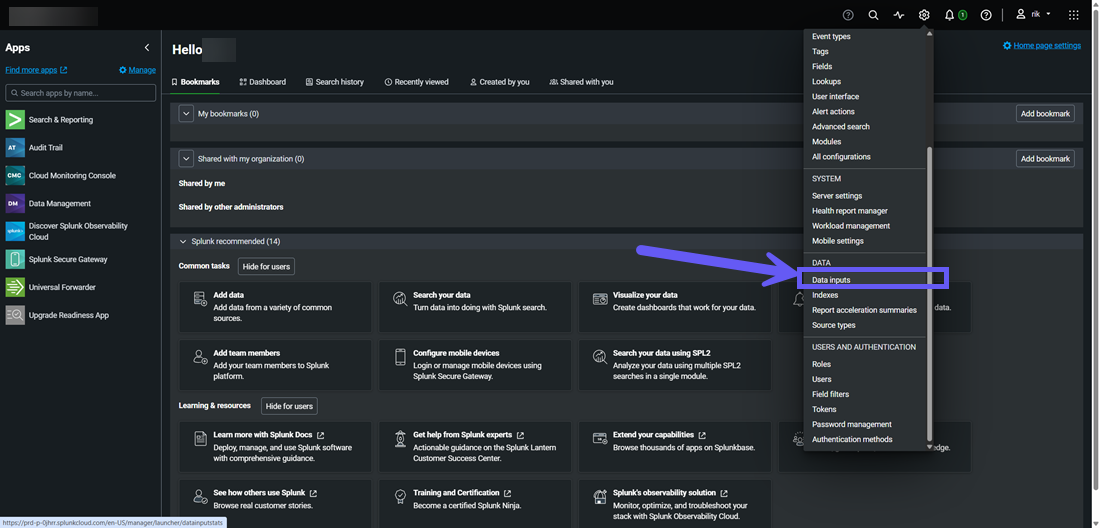
-
From the Data Inputs window that opens, select the HTTP Event Collector option.
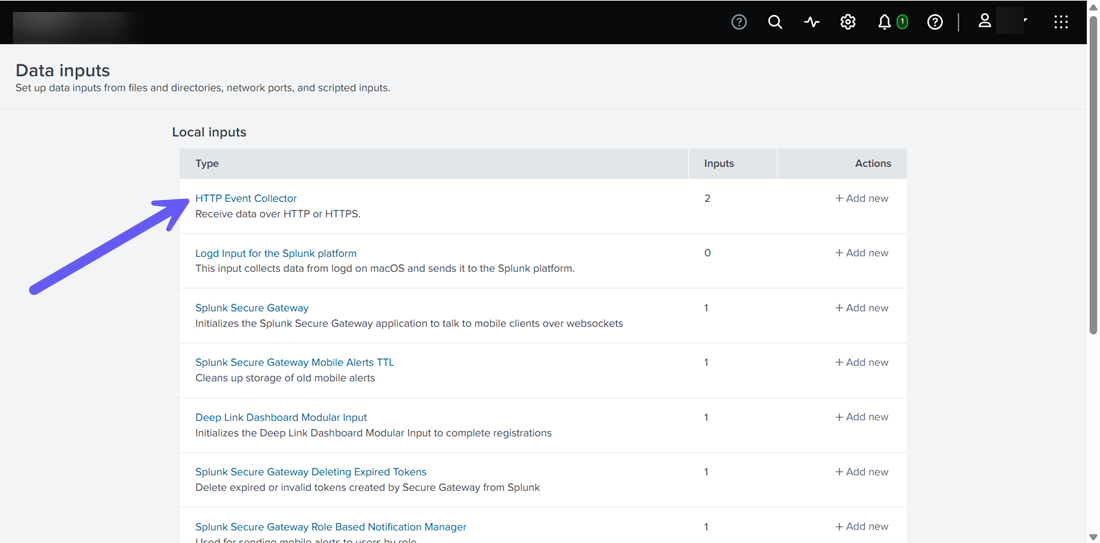
-
Next, click on the New Token button.
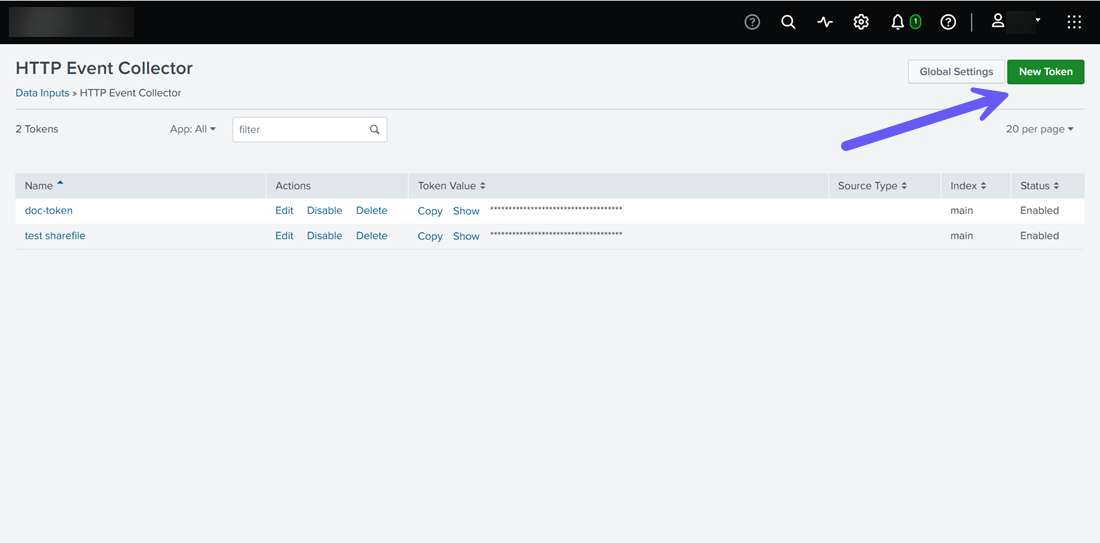
-
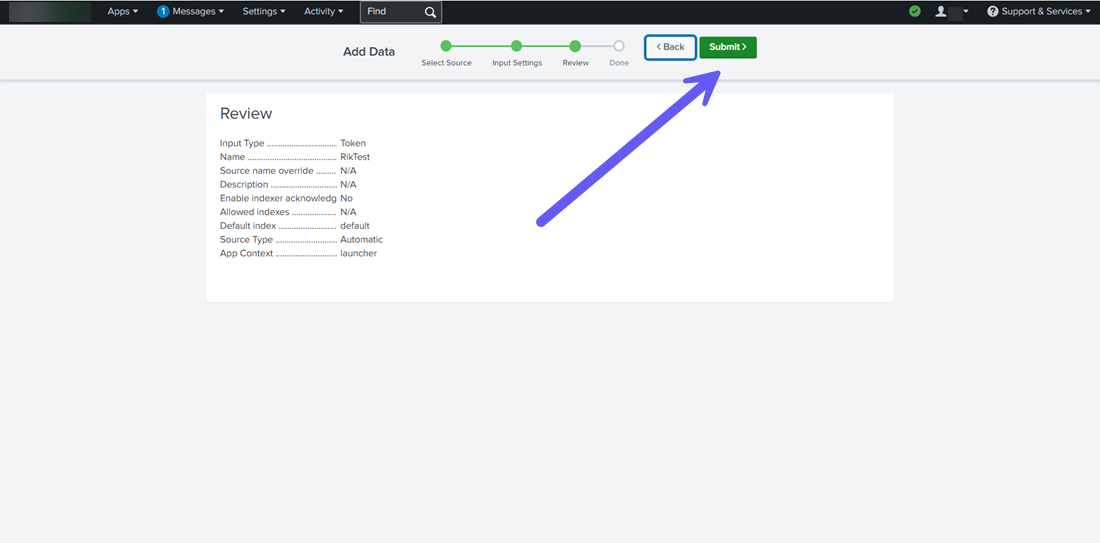
From the screen that is displayed, fill in the name field and select the Next option. Review the fields and click on the Submit button.
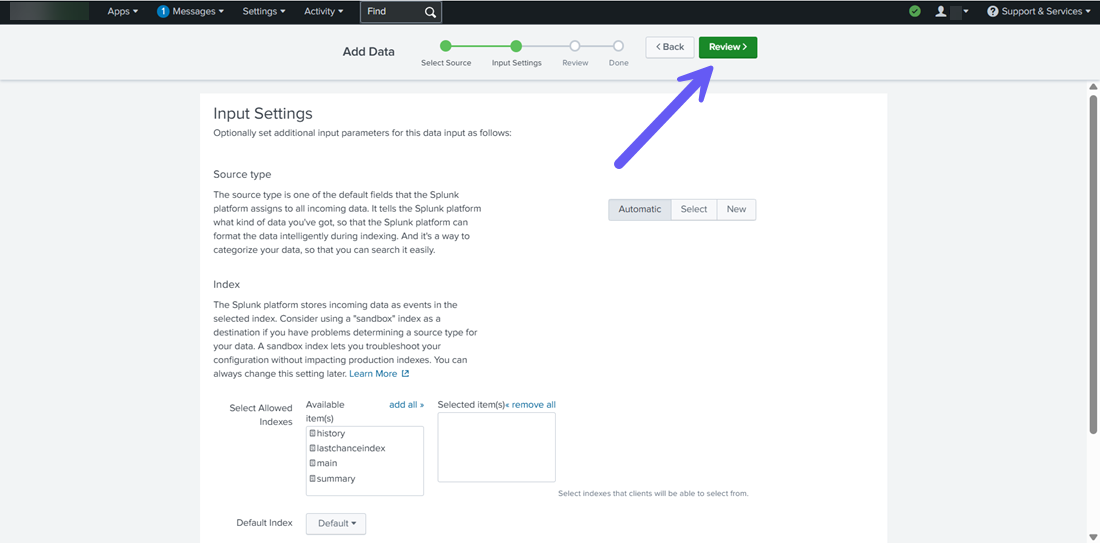
-
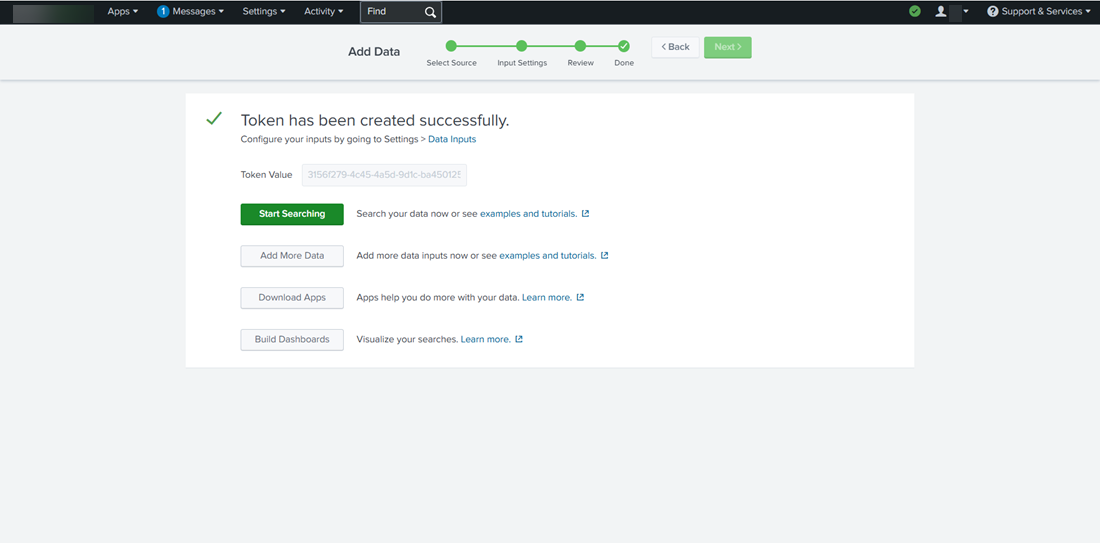
The “Token has been created successfully” success message is shown and from the page that opens, copy the token generated. You can alternatively access the token later from Data Inputs → HTTP Event Collector.
Configuring Splunk Integration with ShareFile
Once you have the Splunk credentials ready, you need to set up the integration with ShareFile. To do so, start by logging into your ShareFile account.
-
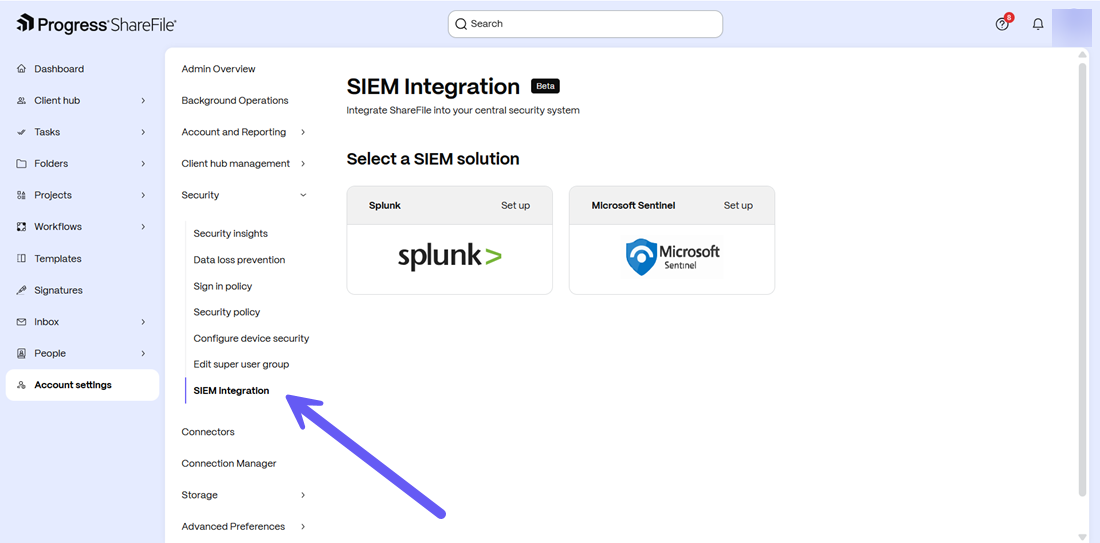
From the ShareFile Dashboard, go to Account settings --> Security --> SIEM Integration.
-
From the SIEM Integration page, locate Splunk and click on the Set up option.
-
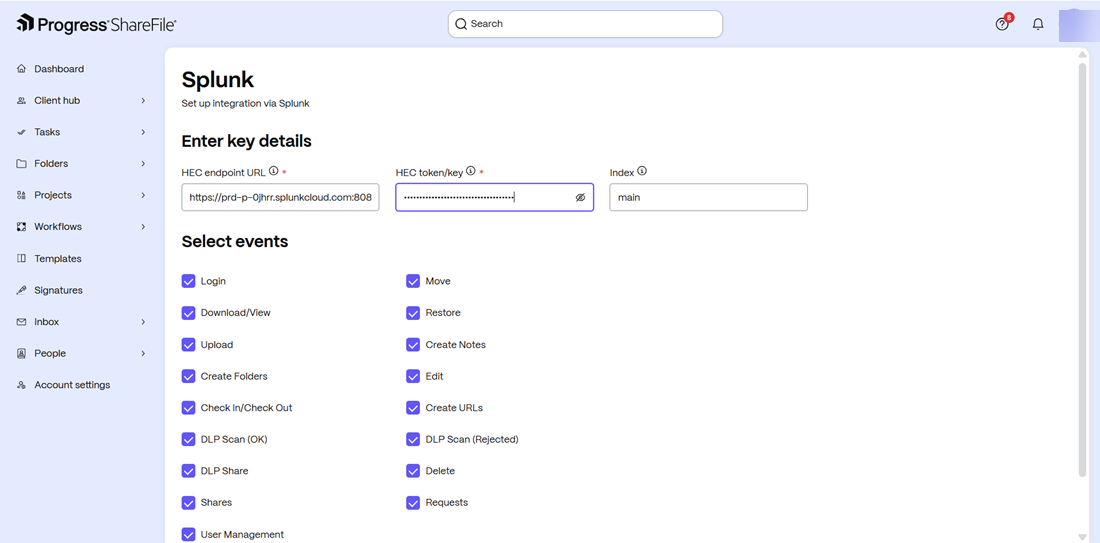
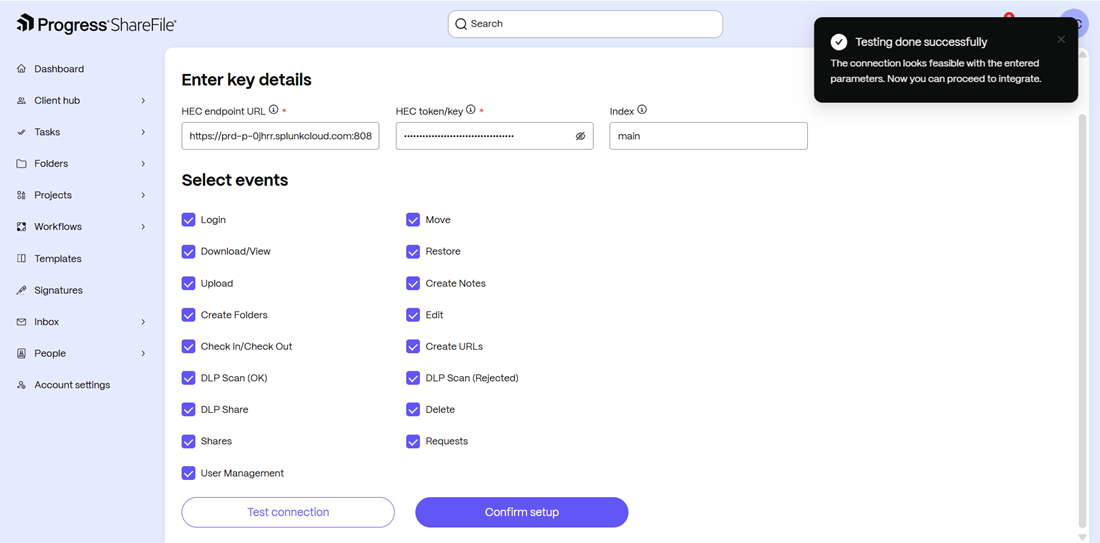
From the Splunk Integration page that opens, enter the HEC endpoint and token that you have generated with Splunk. You can add the index as required or you can add Main as default.
-
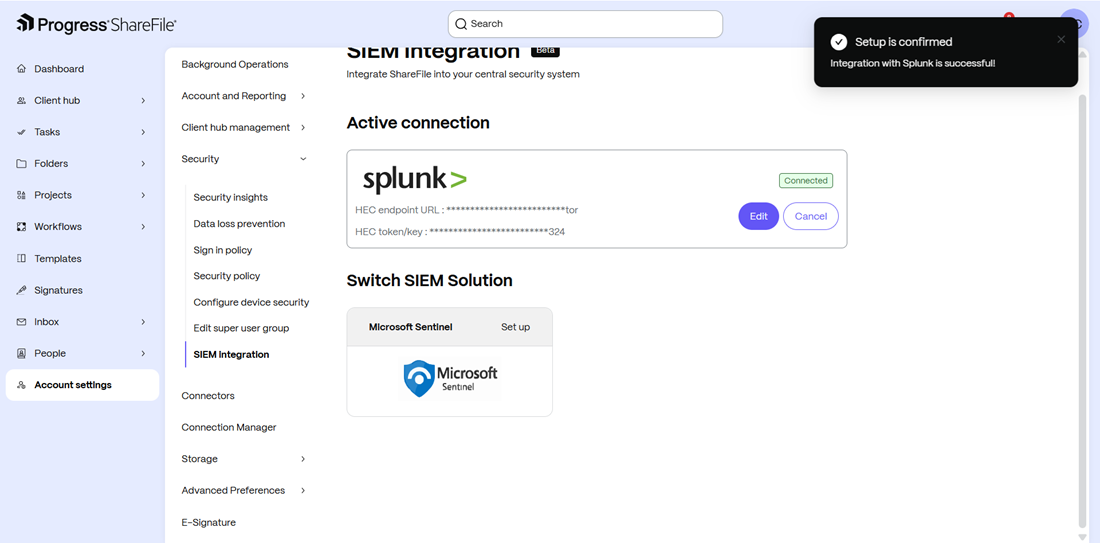
Once all details have been entered, then test the connection by choosing the Test connection button. A success message will appear indicating whether the connection was successful or failed. Confirm the setup once the connection is successful. Upon successful integration, the final setup will look like below:
-
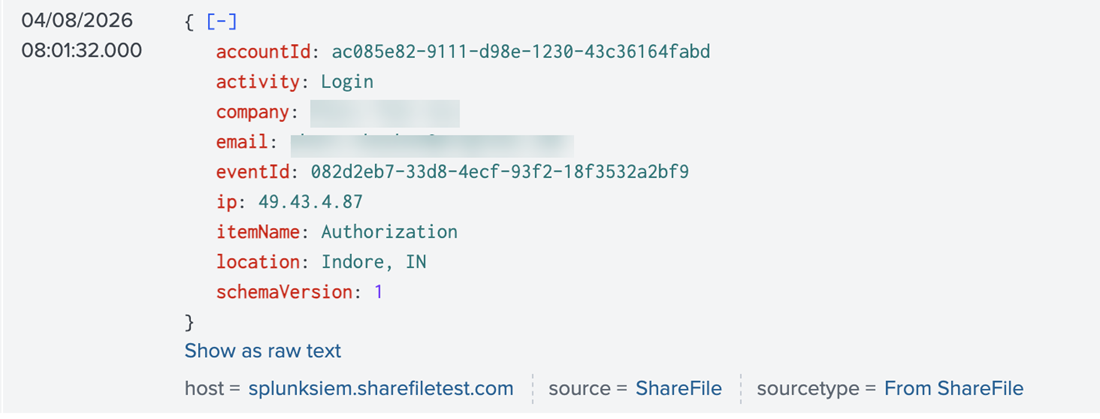
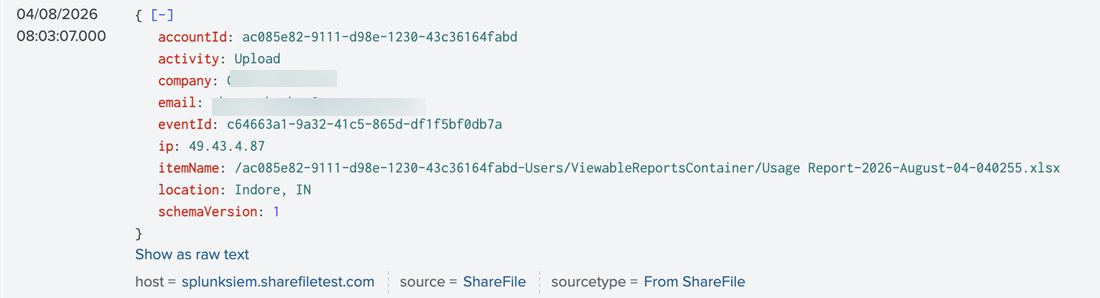
You can view all logs recorded from ShareFile in your Splunk account as shown below:
Types Of Event Forwarding
The following section lists the ShareFile activity types discovered in the SIEM usage report.
Common field parameters in Splunk Events
| Name | Description |
|---|---|
| itemName | File, folder, or object path |
| activity | Type of ShareFile activity |
| Actor’s email address | |
| company | Organization or tenant name |
| ip | Source IPv4 address |
| location | Geo/IP-derived location string |
| eventId | Unique event identifier |
| accountId | ShareFile accountId a****** |
| additionalInfo | Extra Fields related to the event |
Create URL
{
"activity":"Create URL",
"accountId":"a086f4f5-45ea-5d5e-1eb4-dc2e9cef32bf",
"itemName":"/users/emily.watson@examplecorp.com/links/onboarding-kit",
"email":"emily.watson@examplecorp.com",
"company":"ExampleCorp",
"ip":"52.118.34.91",
"location":"US, Ashburn, Virginia",
"eventId":"b24f5ce2-06ad-4a98-a502-0f92a97f31de"
}
Create Note
{
"activity":"Create Note",
"accountId":"a086f4f5-45ea-5d5e-1eb4-dc2e9cef32bf",
"itemName":"/projects/alpha/requirements.docx",
"email":"rahul.iyer@acmecorp.com",
"company":"AcmeCorp",
"ip":"20.53.71.33",
"location":"IN, Bengaluru, Karnataka",
"eventId":"9a5d389e-4d12-4d72-a3ce-3c4b67d16291"
}
Move File
{
  "activity":"Move File",
   "accountId":"a086f4f5-45ea-5d5e-1eb4-dc2e9cef32bf",
  "itemName":"/departments/hr/2026/policies/leave-policy.pdf",
  "email":"laura.chen@contoso.com",
  "company":"Contoso Ltd",
  "ip":"40.76.122.141",
  "location":"US, San Francisco, California",
  "eventId":"1b934dc4-8bbd-4e05-891b-0044157059e2"
}
Create Folder
{
  "activity":"Create Folder",
  "accountId":"a086f4f5-45ea-5d5e-1eb4-dc2e9cef32bf",
  "itemName":"/teams/engineering/releases/2026.1/",
  "email":"michael.turner@apexsystems.com",
  "company":"Apex Systems",
  "ip":"103.44.18.231",
  "location":"IN, Hyderabad, Telangana",
  "eventId":"ec4babb4-6f94-4bd0-8aa5-7b59ad02dda1"
}
Edit File
{
  "activity":"Edit File",
  "accountId":"a086f4f5-45ea-5d5e-1eb4-dc2e9cef32bf",
  "itemName":"/design/ui/mockups/homepage-v5.sketch",
  "email":"samantha.reyes@examplecorp.com",
  "company":"ExampleCorp",
  "ip":"52.154.201.16",
  "location":"US, Phoenix, Arizona",
  "eventId":"dc0e8b97-67c4-477e-8fcc-cc3b5ae80a43"
}
Check In
{
  "activity":"Check In",
  "accountId":"a086f4f5-45ea-5d5e-1eb4-dc2e9cef32bf",
  "itemName": "/personal/file_check_in.txt"
  "email":"aditya.menon@acmecorp.com",
  "company":"AcmeCorp",
  "ip":"49.204.33.51",
  "location":"IN, Bengaluru, Karnataka",
  "eventId":"60a0fbe7-e09d-4b49-8bd9-83036e1d7a61"
}
Restore File
{
  "activity":"Restore File",
  "accountId":"a086f4f5-45ea-5d5e-1eb4-dc2e9cef32bf",
  "itemName":"/archives/clients/2024/contract-final.pdf",
  "email":"daniel.cooper@contoso.com",
  "company":"Contoso Ltd",
  "ip":"20.75.91.12",
  "location":"US, Chicago, Illinois",
  "eventId":"4934c685-f4fc-46ef-8ff5-a10c23f86c77"
}
Delete File
{
  "activity":"Delete File",
  "accountId":"a086f4f5-45ea-5d5e-1eb4-dc2e9cef32bf",
  "itemName":"/temp/uploads/system-dump.log",
  "email":"priya.sharma@examplecorp.com",
  "company":"ExampleCorp",
  "ip":"122.172.66.212",
  "location":"IN, Mumbai, Maharashtra",
  "eventId":"e12db4d4-2bae-4fcf-a63a-d325ccdd0106"
}
View
{
  "activity":"View",
  "accountId":"a086f4f5-45ea-5d5e-1eb4-dc2e9cef32bf",
  "itemName":"/security/policies/zero-trust-overview.pdf",
  "email":"kevin.brooks@acmecorp.com",
  "company":"AcmeCorp",
  "ip":"18.221.44.99",
  "location":"US, Columbus, Ohio",
  "eventId":"0c94a7dc-55d1-4cd0-b39d-150e7a2ea33f"
}
Download
{
  "activity":"Download",
  "accountId":"a086f4f5-45ea-5d5e-1eb4-dc2e9cef32bf",
  "itemName":"/shared/resources/hr/employee-handbook.pdf",
  "email":"aisha.khan@contoso.com",
  "company":"Contoso Ltd",
  "ip":"54.184.122.45",
  "location":"US, Portland, Oregon",
  "eventId":"43d97df6-d346-43e5-ab09-6ccd8d28d96a"
}
Upload
{
  "activity":"Upload",
  "accountId":"a086f4f5-45ea-5d5e-1eb4-dc2e9cef32bf",
  "itemName":"/marketing/assets/2026-campaign/banner-final.png",
  "email":"isabella.wright@examplecorp.com",
  "company":"ExampleCorp",
  "ip":"44.232.110.22",
  "location":"US, Seattle, Washington",
  "eventId":"f7627cdf-b1f0-4f3c-b94b-a566d6e9e64f"
}
Check Out
{
  "activity":"Check Out",
  "accountId":"a086f4f5-45ea-5d5e-1eb4-dc2e9cef32bf",
  "itemName":"/finance/budgets/2026/master-budget.xlsx",
  "email":"jonathan.lee@acmecorp.com",
  "company":"AcmeCorp",
  "ip":"73.221.51.112",
  "location":"US, Denver, Colorado",
  "eventId":"8e87e8ef-22d7-4875-8004-772dca4defba"
}
Login
{
"activity":"Login",
"accountId":"a086f4f5-45ea-5d5e-1eb4-dc2e9cef32bf",
"itemName":"Authentication",
"email":"nathan.roberts@contoso.com",
"company":"Contoso Ltd",
"ip":"52.14.102.55",
"location":"US, Indianapolis, Indiana",
"eventId":"c79b17e0-e17b-4b7f-bd20-fc8cf9c7f41c"
}
Login Fail
{
"activity":"LoginFail",
"accountId":"a086f4f5-45ea-5d5e-1eb4-dc2e9cef32bf",
"itemName":"Authentication",
"email":"unknown@contoso.com",
"company":"Contoso Ltd",
"ip":"185.244.32.91",
"location":"NL, Amsterdam, North Holland",
"eventId":"ad80a090-52f3-4eca-a91a-2f12cc88aac7"
}
Create Share
{
 "ip": "43.247.158.229",
 "accountId": "a2b470ae-4b74-f7df-7135-5db14786b968",
 "eventId": "edc1ca90-59cc-4499-b94e-a5159488d868",
 "email": "jonathan.lee@acmecorp.com",
 "company": "AcmeCorp",
 "location": "Bengaluru, IN",
 "itemName": "",
 "schemaVersion": 1,
 "additionalInfo": {
  "shareId": "s693e14f2175e4dc8bd2e706b9ef12519",
  "shareItems": [
   {
    "id": "fi09b417-ce68-0517-4312-36ce765442b3",
    "name": "testJsonForSentinel.json"
   },
   {
    "id": "fi0e3b3e-9aab-fe78-3068-c6c34c447de1",
    "name": "CPO-AWS SSO Model - Using the AWS CLI-070426-043709.pdf"
   }
  ]
 },
 "activity": "Create Share"
}
Send Share
{
 "accountId": "a2b470ae-4b74-f7df-7135-5db14786b968",
 "activity": "Send Share",
 "additionalInfo": {
  "shareId": "s693e14f2175e4dc8bd2e706b9ef12519",
  "shareItems": [
   {
    "id": "fi09b417-ce68-0517-4312-36ce765442b3",
    "name": "testJsonForSentinel.json"
   },
   {
    "id": "fi0e3b3e-9aab-fe78-3068-c6c34c447de1",
    "name": "CPO-AWS SSO Model - Using the AWS CLI-070426-043709.pdf"
   }
  ],
  "shareRecipientEmailIds": [
   "jonathan.lee@acmecorp.com",
   "priya.sharma@examplecorp.com"
  ],
  "shareRecipientIds": [
   "8b976430-870f-48c8-9e5b-7ce4b5524f6e",
   "377aa1cd-ffa7-4403-9912-d6466505af73"
  ]
 },
 "company": "AcmeCorp",
 "email": "jonathan.lee@acmecorp.com",
 "eventId": "8ca67438-9d86-4880-a6ce-eb00a561abc6",
 "ip": "43.247.158.229",
 "itemName": "",
 "location": "Bengaluru, IN",
 "schemaVersion": 1
}
Create Request
{
 "accountId": "a2b470ae-4b74-f7df-7135-5db14786b968",
 "activity": "Create Request",
 "additionalInfo": {
  "requestId": "r8c1efffe9e4742088e328c7252d59e22"
 },
 "company": "AcmeCorp",
 "email": "jonathan.lee@acmecorp.com",
 "eventId": "4dc48c73-03ac-405b-87cb-b6d2ca6f508f",
 "ip": "43.247.158.229",
 "itemName": "",
 "location": "Bengaluru, IN",
 "schemaVersion": 1
}
Send Request
{
 "accountId": "a2b470ae-4b74-f7df-7135-5db14786b968",
 "activity": "Send Request",
 "additionalInfo": {
  "requestId": "r8c1efffe9e4742088e328c7252d59e22",
  "shareRecipientEmailIds": [
   "jonathan.lee@acmecorp.com",
   "priya.sharma@examplecorp.com"
  ],
  "shareRecipientIds": [
   "8b976430-870f-48c8-9e5b-7ce4b5524f6e",
   "377aa1cd-ffa7-4403-9912-d6466505af73"
  ]
 },
 "company": "AcmeCorp",
 "email": "jonathan.lee@acmecorp.com",
 "eventId": "619210f9-5b3b-466b-867b-e37834d8af30",
 "ip": "43.247.158.229",
 "itemName": "",
 "location": "Bengaluru, IN",
 "schemaVersion": 1
}
User Create
{
  "accountId": "a2b470ae-4b74-f7df-7135-5db14786b968",
  "activity": "User Create",
  "additionalInfo": {
    "targetFirstName": "Paul",
    "targetLastName": "Atreides",
    "targetRole": "Employee",
    "targetUserEmail": "paul.atreides@dune.com",
    "targetUserId": "7bc7d159-b082-4768-acf4-12e4e4a61d10"
  },
  "company": "AcmeCorp",
  "email": "jonathan.lee@acmecorp.com",
  "eventId": "0e3c340c-26e9-4648-bbb9-47cb6109d2a4",
  "ip": "43.247.158.229",
  "itemName": "User Account",
  "location": "Bengaluru, IN",
  "schemaVersion": 1
}
User Delete
{
 "accountId": "a2b470ae-4b74-f7df-7135-5db14786b968",
 "activity": "User Delete",
 "additionalInfo": {
  "targetFirstName": "Paul",
  "targetLastName": "Atreides",
  "targetRole": "Employee",
  "targetUserEmail": "paul.atreides@dune.com",
  "targetUserId": "7bc7d159-b082-4768-acf4-12e4e4a61d10"
 },
 "company": "AcmeCorp",
 "email": "jonathan.lee@acmecorp.com",
 "eventId": "571f680e-de05-4772-a95e-f4dc5f84b5e0",
 "ip": "43.247.158.229",
 "itemName": "User Account",
 "location": "Bengaluru, IN",
 "schemaVersion": 1
}
Troubleshooting
1. My events are not appearing in my SIEM. What should I check?
Verify:
- The endpoint URL is correct.
- Authentication credentials are valid.
- Firewalls allow outbound HTTPS traffic.
- Event categories are enabled in ShareFile.
If the issue persists, review the SIEM Integration status page in ShareFile or contact ShareFile Support.
2. My authentication token has changed. What should I do?
Update the authentication credentials in the ShareFile SIEM configuration page. Events will resume automatically after the new credentials are saved.
3.Can I test my SIEM configuration?
Yes. ShareFile allows administrators to send a test event to verify connectivity before enabling continuous event streaming.
Privacy & Compliance
1. Does ShareFile modify my SIEM data?
No. ShareFile only transmits events. It never modifies, queries, or deletes information within your SIEM.
2. Can I disable SIEM Integration at any time?
Yes. Administrators can disable SIEM Integration from the ShareFile Admin Settings page at any time. Once disabled, no new events will be sent.
Best Practices
What are the recommended best practices?
We recommend:
- Use a dedicated ingestion endpoint for ShareFile.
- Rotate authentication tokens periodically.
- Monitor connection health regularly.
- Review event filters periodically to ensure only relevant data is forwarded.
- Build dashboards for common security scenarios such as failed logins, high download activity and administrative changes.
Frequently Asked Questions (FAQ)
General
What is ShareFile SIEM Integration?
ShareFile SIEM Integration enables administrators to automatically stream ShareFile activity logs to their organization's Security Information and Event Management (SIEM) platform. This allows security teams to monitor ShareFile alongside other enterprise systems from a centralized Security Operations Center (SOC).
Which SIEM platforms are supported?
ShareFile supports:
- Splunk
- Microsoft Sentinel
Additional SIEM platforms may be supported in future releases.
What data does ShareFile send to my SIEM?
ShareFile sends:
- Activity Logs
- User sign-ins
- Failed sign-ins
- File uploads
- File downloads
- File edits
- File deletions
- Folder creation
- Share creation and sending
- Request creation and sending
- Administrative user management events
- Other supported account activity
Does ShareFile send data in real time?
Yes. Security alerts are streamed in near real time. Activity logs are continuously streamed with minimal delay.
Configuration
What information do I need to configure SIEM Integration?
Depending on your SIEM platform, you'll typically need:
- Endpoint URL
- Authentication token or API key
- Required HTTP headers (if applicable)
Refer to the setup guide for your specific SIEM.
Can I connect multiple SIEM platforms?
No. Each ShareFile account supports one active SIEM destination.
Can I choose which events are sent?
Yes. Administrators can configure which event categories are forwarded to their SIEM.
Who can configure SIEM Integration?
Only ShareFile administrators with the appropriate administrative permissions can configure or modify SIEM settings.
How is my SIEM authentication token stored?
Authentication credentials are encrypted at rest and protected using ShareFile's secure credential management practices.
Does ShareFile have access to my SIEM?
No. ShareFile only sends event data to the endpoint you configure. It cannot read, modify, search, or delete data stored within your SIEM.
Is my data encrypted during transmission?
Yes. All communication between ShareFile and your SIEM endpoint uses HTTPS with TLS encryption.
What happens if my SIEM is unavailable?
ShareFile automatically retries delivery for temporary failures. If delivery cannot be completed after multiple retry attempts, events are placed into a secure Dead Letter Queue (DLQ). Administrators are notified when delivery failures require attention.
Will I lose events if my SIEM is offline?
Not immediately. ShareFile retries delivery automatically before moving undelivered events to the Dead Letter Queue. The retention period for failed events depends on your organization's configuration and ShareFile service limits.
How will I know if my SIEM connection fails?
ShareFile notifies administrators through:
- In-app notifications
- Email notifications
These notifications include guidance for resolving the issue.
Can I retry failed deliveries?
No. This feature will be added in a future release.
What information is included in each event?
Refer to
Does ShareFile send document contents?
No. ShareFile only sends metadata describing the activity. Document contents are never transmitted to your SIEM.
Does ShareFile send file names?
Yes. When applicable, activity events include the file or folder name associated with the action.
Are recipient email addresses included for shared files?
Yes. Share and Request events include recipient information when applicable.
Are deleted events removed from my SIEM?
No. Once an event has been delivered, ShareFile cannot remove it from your SIEM. Retention and deletion are controlled by your SIEM platform.
Which Splunk deployment types are supported?
ShareFile supports Splunk environments that expose an HTTP Event Collector (HEC) endpoint. This includes both Splunk Cloud Platform and Splunk Enterprise deployments configured with HEC.
Do I need to install a Splunk App?
No. ShareFile sends structured JSON events directly to Splunk through HEC. No additional ShareFile application is required.
Can I build custom dashboards?
Yes. All ingested fields are searchable using Splunk Search Processing Language (SPL) or Sentinel Kusto Query Language (KQL). You can create custom dashboards, alerts, reports, and correlation searches.
Can I create analytics rules using ShareFile events?
Yes. Once ingested, ShareFile events can be used in:
- Analytics Rules
- Workbooks
- Hunting Queries
- Automation Rules
- Microsoft Defender XDR investigations
Is SIEM Integration available on all ShareFile plans?
Availability depends on your ShareFile plan. Contact your ShareFile representative if you're unsure whether SIEM Integration is included in your plan.