This content has been machine translated dynamically.
Dieser Inhalt ist eine maschinelle Übersetzung, die dynamisch erstellt wurde. (Haftungsausschluss)
Cet article a été traduit automatiquement de manière dynamique. (Clause de non responsabilité)
Este artículo lo ha traducido una máquina de forma dinámica. (Aviso legal)
此内容已经过机器动态翻译。 放弃
このコンテンツは動的に機械翻訳されています。免責事項
이 콘텐츠는 동적으로 기계 번역되었습니다. 책임 부인
Este texto foi traduzido automaticamente. (Aviso legal)
Questo contenuto è stato tradotto dinamicamente con traduzione automatica.(Esclusione di responsabilità))
This article has been machine translated.
Dieser Artikel wurde maschinell übersetzt. (Haftungsausschluss)
Ce article a été traduit automatiquement. (Clause de non responsabilité)
Este artículo ha sido traducido automáticamente. (Aviso legal)
この記事は機械翻訳されています.免責事項
이 기사는 기계 번역되었습니다.책임 부인
Este artigo foi traduzido automaticamente.(Aviso legal)
这篇文章已经过机器翻译.放弃
Questo articolo è stato tradotto automaticamente.(Esclusione di responsabilità))
Translation failed!
Templates Library
ShareFile provides access to all of your templates and templates shared with you in the Templates library. The use of Sharefile templates also provide the following:
- Easily access and reuse templates across ShareFile
- Manage all templates in a single location
- Create and save personal templates for frequently used projects, documents, requests, and workflows
- Share and access organization-wide templates for consistent collaboration with your team
Use the Templates to access, create, share, and store various templates including:
- Document Templates - Used to automatically create highly personalized/customized documents and agreements
- Project Templates - Used to define a specific, time-bound effort with well-defined objectives and tasks
- Information Request Templates - Used under projects to collect information from external clients or stakeholders
- Automated Workflow Templates - Used to create a sequence or set of actions that ShareFile can automate and help users eliminate repetitive tasks
- Document Request Templates – Used to streamline the process of requesting and collecting specific documents from clients.
- Partner Templates - Access templates created by leading industry experts and tailored for specific industries.
Accessing or creating templates
We recommend watching this video about using templates for your ShareFile projects:
Your ShareFile app provides several ways to access/create templates.
-
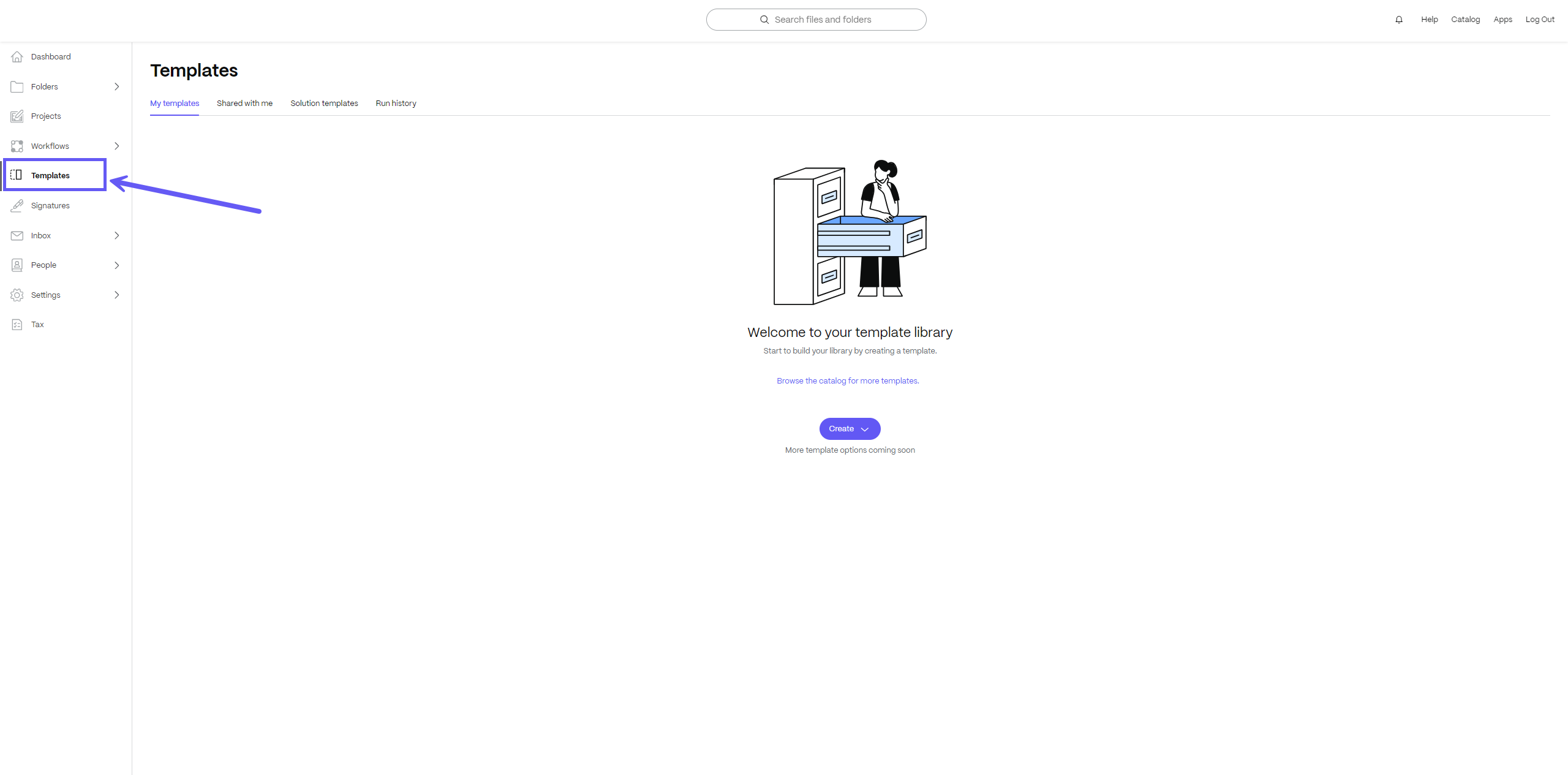
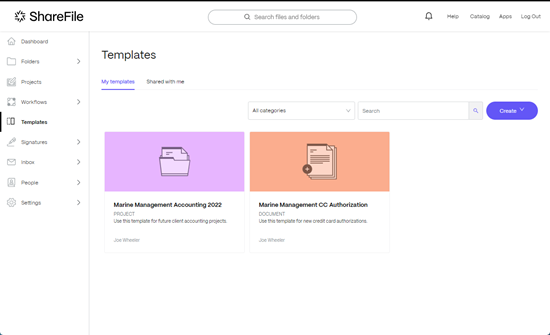
Open ShareFile then navigate to Templates.
-
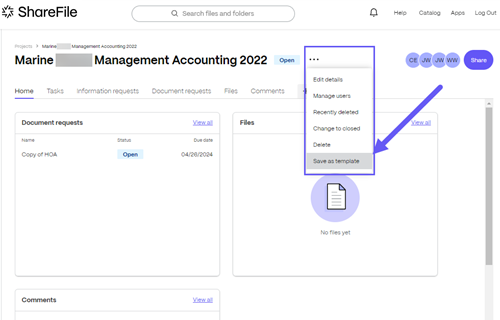
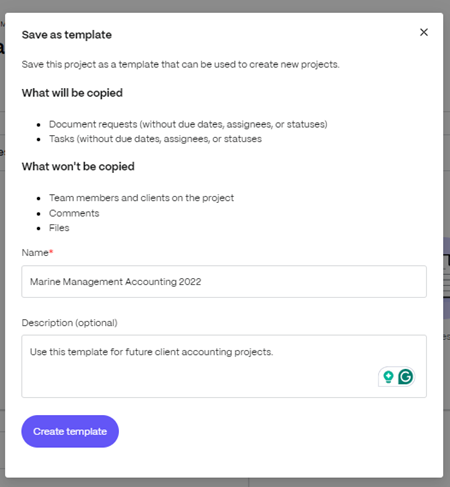
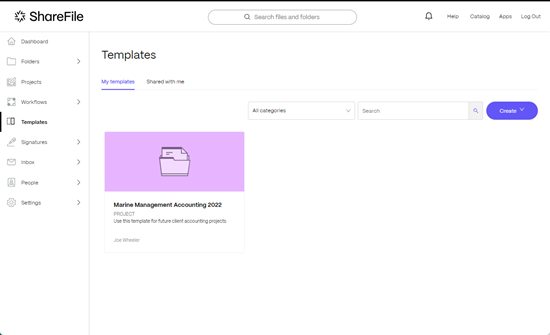
Open ShareFile then navigate to Projects then open a project. Once open, select the Save as template option on the … menu. This allows you to save the project as a template that can be used to create new projects.
-
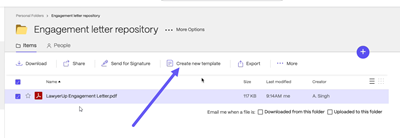
Open ShareFile then navigate to Folders > select a PDF file > Create new template.
-
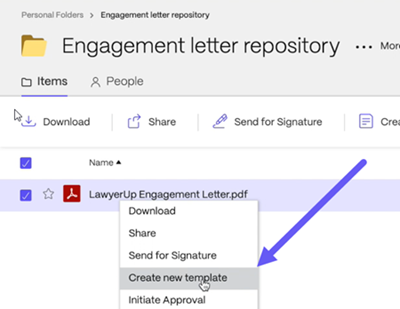
Open ShareFile then navigate to Folders > select a PDF file > Right-click to open the menu > select Create new template.
-
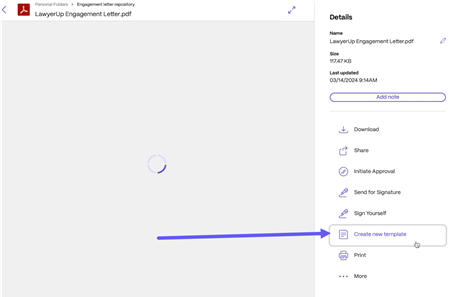
Open ShareFile then navigate to Folders > select a PDF file to open in Preview. Select Create new template from the Preview menu.
Using the Catalog to add templates to your library
Use the ShareFile Catalog to access and add pre-made templates to your Template library.
-
Select Create from your Template library.
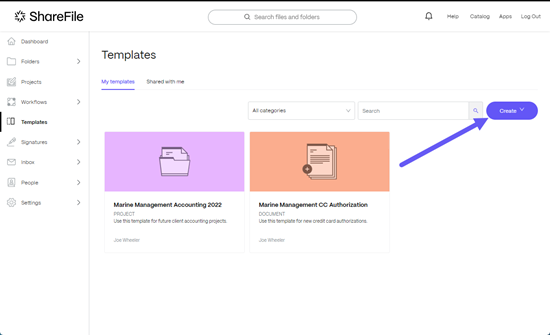
-
Select Browse catalog.
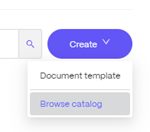
The ShareFile Catalog opens.
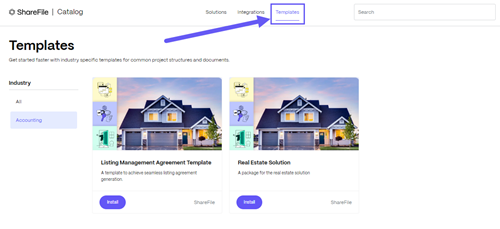
-
Select the Templates tab from the menu.
-
Select Install on the template you want to add.
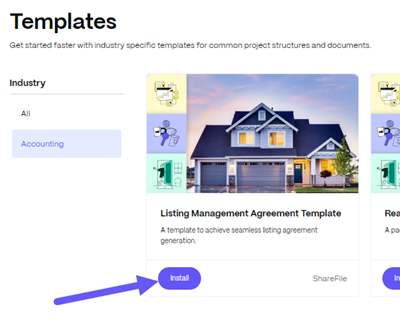
-
Select Install on the confirmation popup.
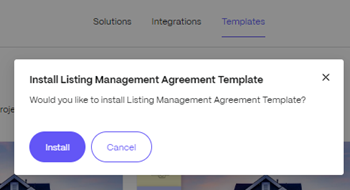
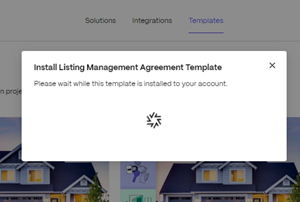
The template installation message displays.
-
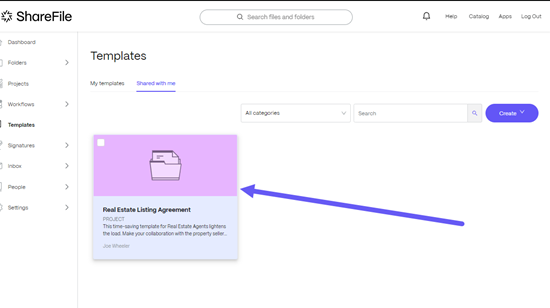
Return to your ShareFile Templates library and select the Shared with me tab to see the template you installed from the catalog.
Transparent Progress on Long-Running Automation Processes
Overview
Transparent Automation Progress by ShareFile gives users confidence that the process automations are working as expected by surfacing real-time status, progress, and outcomes directly in the ShareFile UI. Instead of guessing whether something is happening behind the scenes, you can now see exactly what’s running, what’s completed, and when action may be required.
This new enhancement introduces transparent, real-time visibility into automation execution across ShareFile. Users can clearly see when an automation starts, is running, completes, or fails, reducing uncertainty, duplicate actions, and support requests.
Who Benefits
Enabled for ShareFile Plans
-
Plans: All ShareFile plans
-
Typical users:
- Employee users executing automations
- Admins monitoring operational workflows
- Support teams handling automation-related tickets
Platform Scope
- Available on: Web
- Not available on: Mobile (initial release)
Key Capabilities
| Capability | What It Does | Who Sees It |
|---|---|---|
| Automation start confirmation | Confirms immediately when an automation is triggered. | Employee user |
| Real-time status visibility | Shows whether an automation is running, completed, or failed. | Employee user |
| Long-running progress indicator | Displays “Processing” state with progress or step indication when applicable. | Employee user |
| Automation activity surface | Central place to view ongoing and recent automation activity. | Employee user, Admin |
| Failure visibility | Clearly indicates when an automation fails and requires attention. | Employee user, Admin |
Activation & Availability
Is Transparent Automation Progress enabled by default?
Yes, it is enabled for all supported automation types.
How to enable the automation feature?
No action required for the users. Supported automations automatically surface progress and status when triggered.
How to disable the automation feature?
It is currently not configurable in the initial release.
Known Limitations
- Not all automations will display real-time progress. Automations that:
- Run for extremely long durations (days, weeks, months)
- Pause for human interaction
- Execute fully in the background without user impact may not surface progress to avoid UI noise.
-
Estimated completion times may not be available for all automation types.
- Mobile support is not included in the initial release.
Example Use Case
Typical Scenario
A user triggers an automation to create engagements for multiple clients.
Without Transparent Automation Progress
The automation runs in the background with no visible feedback. The user is unsure if the process started, retries the action, or contacts support.
With Transparent Automation Progress
The user immediately sees confirmation that the automation has started. can track its processing status, and is notified upon completion or failure. Confidence increases, duplicate actions are avoided, and the workflow completes smoothly.
Frequently Asked Questions
What does Transparent Automation Progress show me?
It shows when an automation has started, is running, has completed, or has failed, so you always know what’s happening in the background.
Which automations support real-time progress?
Real-time progress is available for supported, bounded automations such as:
- Creating engagements for multiple clients
- Exporting files to third-party systems
- Template runs
Not all automations are eligible.
Why don’t I see progress for every automation?
Some automations:
- Run for very long periods
- Pause for human input
- Execute entirely in the background
To avoid UI clutter, the automation processes do not display real-time progress.
Where can I see automation progress?
Automation activity appears in notification center.
Will I get notified when an automation finishes?
Yes. You’ll see a clear status update when an automation completes or fails.
Can I see what step the automation is currently on?
When available, the UI will show the current stage or processing state of the automation. This may vary by automation type.
Does this change how automations work?
No. This feature only improves visibility. The underlying automation logic remains unchanged.
Can I turn off automation progress notifications?
No. Automation progress visibility is enabled by default for supported automations and cannot be disabled in the initial release.
Why don’t I see this feature?
Make sure:
- You’re using the web platform.
- You are running an automation that supports real-time progress.
Is this available on mobile?
No. Transparent Automation Progress is web-only in the initial release.
What happens if an automation fails?
You’ll see a failure status in the UI, indicating that the automation did not complete successfully and may require attention.
Does this feature show estimated completion time?
Estimated time is shown only when it can be reliably calculated. Some automations may display a generic “Processing” status instead.
Who can see automation progress?
Employee users running automations can see progress. Admins may also see automation status depending on their role and permissions.
Will this help reduce duplicate work?
Yes. By clearly showing automation status, users are less likely to retry actions or manually repeat tasks.
Share
Share
This Preview product documentation is Citrix Confidential.
You agree to hold this documentation confidential pursuant to the terms of your Citrix Beta/Tech Preview Agreement.
The development, release and timing of any features or functionality described in the Preview documentation remains at our sole discretion and are subject to change without notice or consultation.
The documentation is for informational purposes only and is not a commitment, promise or legal obligation to deliver any material, code or functionality and should not be relied upon in making Citrix product purchase decisions.
If you do not agree, select I DO NOT AGREE to exit.